
This is one of the most attractive subspecies of garter snakes. The blackneck has a distribution throughout much of Texas and Arizona, but itis the eastern subspecies, ocellatus, that is by far the most attractive. It is mainly restrictedto the hill country region of south Texas.
I acquired a pair of these animalsin May 1998. They were wild-caught adults, and took over a year to fully establishand settle down. The species has a reputation for being very much a frog-eater, andinitially I found I had to scent fish-based prey with a live frog to get the snakesto eat it. These animals bred successfully (23 babies) in 2000, but sadly the femaledied in hibernation the following year.
In June 2000 I acquired un unrelatedtrio of juveniles. These have bred in both 2002, 2003 and 2004, producing attractive healthybabies. These babies require rather more work than the majority of baby garters, as, like the adults, their preferred food is frogs. Around 50% of the babies take reasonably well to dead food, but the remaining babies often require 'kick-starting' with live food, such as a live guppy. Once they have taken their first feed, they will usually switch to live food. They are quite large babies at birth, and rarely show interest in food until around 2-3 weeks of age.


Clickon image to enlarge


clickon image to enlarge
 Go to top of page
This is one of the most beautiful and sought-after of all garter snakes, andindeed of snakes in general. It is highly endangered in the wild, and close to extinction.This is due to a combination of over-collecting for the pet trade, and habitat destruction.
Inthe 1980s the San Francisco garter snake was being successfully bred in a numberof US zoos. Captive-bred specimens were released to European zoos specialising inendangered species, and during the next decade large numbers were bred in JerseyZoo in the Channel Islands, Rotterdam Zoo in Holland, and Lodz Zoo in Poland. Underthe terms that these zoos released the animals from US Fish and Wildlife, they wereprevented from releasing them to the public, so most of the zoos stopped breedingthem as they could not dispose of the offspring. There were even suggestions thatsurplus San Francisco garter snakes were being used to feed ophidophagic snakes, suchas King Cobras!
Ultimately specimens did reach the European breeders, andthe San Francisco garter snake is commercially available in Europe. Under internationallaw it is not protected, as CITES (Convention of International Trade in EndangeredSpecies) recognises species, but not subspecies, so the San Francisco garter is nodifferent to any other Thamnophis sirtalis.
The main problem with the speciesnow is of in-breeding. The entire European stock has been in-bred for many generationsfrom a small number of imported animals. The manifestations of in-breeding have becomemore pronounced:- low fertility rates, small litters, reduced survival of adult animals,and a susceptibility to skin tumours, which these animals often develop at a youngage.
I understand that animals from fresh genetic stock are now availablein Europe, and that breeding is taking place (see under "ARTICLES" in Chlebowy'sGarter Snake World).
My own animals are from different sources, and the newest pair are thought to be from the 'new' strain. They did not produce babies in 2005, but it is hoped that they will in 2006.


 Go to top of page
This is one of the most beautiful garter snakes in existence, and isthe less attractive relative of the San Francisco garter snake, with which it intergrades.It occurs on coastal California, and in fact is now no longer called T s infernalis(which name is reserved for the San Francisco subspecies), but is classified alongwith T s concinnus. I have reverted to the original names for the purpose of thissite.
My present collection consists of two adult females, and one male.In 2002 one female bred with a male San Francisco garter, producing only 5 healthybabies, 4 of which were typical of infernalis, and one of tetrataenia. However, itis hoped that future breedings will not require intergrading. ( This is not reallyan 'unnatural' breeding, as such intergrades occur naturally in the wild, or at leastdid prior to mankind artificially separating these subspecies by destroying habitatlinking populations, and may help prevent the in-breeding problems that are universalthroughout San Francisco garters in Europe.)


Click on image to enlarge
This is a small but beautifully-coloured subspecies, found along the Oregon and Californian coast. I have a pair of these purchased in late 1999 from a US breeder, and another pair, unrelated to the first, acquired in 2000. Both pairs are breeding, producing attractive babies, which are the most voracious feedingand fast growing baby garters I have come across.
The babies of these garters are somewhat differently coloured to the adults:- the adults lack a pale side stripe, and the belly and sides are black, broken only by the vertical red bars. The juveniles look a little more like infernalis, with a pale side stripe. This stripe disappears over the first few months of life.
The second set of pictures below illustrates the process of a baby garter snake being born. It is born in its membrane, from which it breaks free either during birth, or within a few minutes after.


Click on image to enlarge
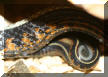
Click on image to enlarge
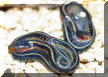
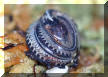
There appears to be some confusion amongst herpetologists as to whatconstitutes the "true" Florida blue garter snake - subspecies "similis"as opposed the blue coloured variant of "sirtalis". True similis are froma limited distribution on the north western Florida peninsula, and thus the majorityof imported Florida garter snakes are not of this subspecies, but are merely a bluestrain of Thamnophis sirtalis sirtalis. After discussion and analysis of photographswith Thamnophis experts of more experience than me (personal communication, JurgenChlebowy, Peter Geissler, Philippe Blais MD,) I accept that my animals are of thenominate subspecies, T s sirtalis.
Florida garter snakes have a reputationfor growing large and being aggressive. I am informed by a reliable witness thathe has captured one animal just over 5 feet (157 cm) in the Everglades.
This is a highly attractive garter snake with impressive blue colouring. All of my stock derives from a mating between a normal female, and an albino male. Unfortunately I have yet to have breeding success with them, and suspect that the albino strain is not a viable one in the long term.


Click on image to enlarge
Go to top of pageThe following pictures show the original albino animal from which the stain was derived. My current animals are heterozygous for this trait, but so far I have had no breeding success with them.


Clickon image to enlarge
Go to top of pageThese animals come from central Saskatchewan, Canada. They are a heavybodied garter snake found in large numbers in some areas.
I have two largefemale radix, imported from Saskatchewan in late summer 1997. They all refused tofeed that year, unless they were offered frogs, which they accepted avidly. Theywere hibernated for three months, and after being warmed up and sloughing three weekslater, commenced feeding very voraciously on home made garter snake food. After twomonths they fed more at the normal rate expected of garter snakes, and from Septemberonwards refused all food. In the wild it is likely that these animals would spendup to 6 months of the year in hibernation.
In September 1999 I acquired ayoung male from the same area as the females. He is just about large enough to breed(approx 18 inches long).
In June 2001 these animals were moved into an outdoorreptile pit in my garden, in East Yorkshire in northern England. The climate hereis not dissimilar to that in Saskatchewan, although our summers are not so hot. However,our winters are milder, and summers longer, and these snakes were active in the outdoorenclosure right up until the end of October. There is a deep frost-proof hibernation chamber in one corner of the enclosure, and so far these animals have survived the winters well.There has been no breeding of these animals outdoors, although one female currently (June 2005) appears as if it may be gravid.


Clickon image to enlarge
Go to top of pageMy main interest in this species is in the one-striped morph, from coastalCalifornia. I currently have one pair of these, and hope that they will breed in2003.
I had a pair back in the 1980s, before I discovered the existence ofthe thiaminase problem of certain fish, and both snakes died of this deficiency,despite initially doing very well. My present animals are eating my home made foodheartily, and I hope to breed these at some point in the future.


Click on image to enlarge
This is a highly variable subspecies of garter snake with wide distribution.The two main forms seen are black and red morphs. Both can occur in the same area,and the amount of red present is highly variable. I have now had to stop keepingthis species, due to lack of cage space.
These snakes are unusual amongstgarters in that they have a reputation for cannibalism. It is recommended that theyare kept singly.


Click on image to enlarge


Click on image to enlarge
This is one of the most commonly seen garter snakes in captivity, andis common throughout much of Texas. It is rather less aquatic than many other garters,and eats a varied diet. It will frequently take mice in captivity.
My ownstock consists of animals originally imported from south Texas. They readily breed,and indeed my two adult females were gravid when imported, and after having 20 babieseach promptly mated with the male inadvertently left in the cage with them, to produceanother 20 babies each just over three months after the first litter. The secondlitter were somewhat smaller snakes than the first, but still had over a 90% survivalrate despite being collectively housed 20 to a tub, and fed exclusively on stripsof home made food, with no intervention of food fights!
There is a reliableaccount of one female Chequered garter snake having four litters, totalling over84 live offspring, in 13 months (personal communication, Mr Bob Riches).
Twoof the September 1998 offspring themselves had ten babies each in August 1999, atless than 11 months old. They had bred with their brother with whom they were housed,and had been kept warm and fed throughout winter.
One of the wild femalesescaped in autumn 1998. She was found by my farmer neighbour in late March 1999,sunning herself on a spring day by his farm buildings. I live in north-east England,on the wind-swept North Sea coast, and that was the warmest day thus far this year- probably in the high 50s. She was none the worse for having survived a Britishwinter, and went on to breed successfully that year, and every year since!


Click on image to enlarge
Go to top of pageThis is the most common albino garter snake available. I acquired a pairin September 1997 in USA and they thrived well on a diet of home made food. Despitethe male having spent ten weeks on the loose in 1998 (and being found under the atticfloorboards!) he mated with the female in 1999. She retained the babies and eventuallydied full of unfertilised slugs. The male has since successfully mated with a normalfemale, and I hope to breed with the heterozygous babies from this mating.
InSeptember 1999 I acquired a new baby female, along with a heterozygous male. Thefemale has been one of the most prolific feeders I have known, and reached 24 incheswithin four months.


Clickon image to enlarge
Go to top of pageThis is an erythristic (high red) variant of the eastern garter snake,found in southern Quebec, Canada. Axanthic (lacking in yellow) specimens are alsofound. These are a spectacular morph of Thamnophis sirtalis, giving the west coastsubspecies of tetrataenia, infernalis and concinnus some serious eastern competitionin the beauty stakes!
I was first made aware of the existence of this strainof garters after reading an article in 'The Vivarium' by Philippe Blais, MD. I havesince been fortunate enough to acquire one male and three females. These are doingvery well, and have bred for the first time in 2003.


Click on image to enlarge


Click on image to enlarge


Go to top of pageThis is a melanistic, or black, form of the eastern garter, common incertain areas of New York state, and in some southern Canadian provinces. Many animals havea spectacular flash of white under the chin.


